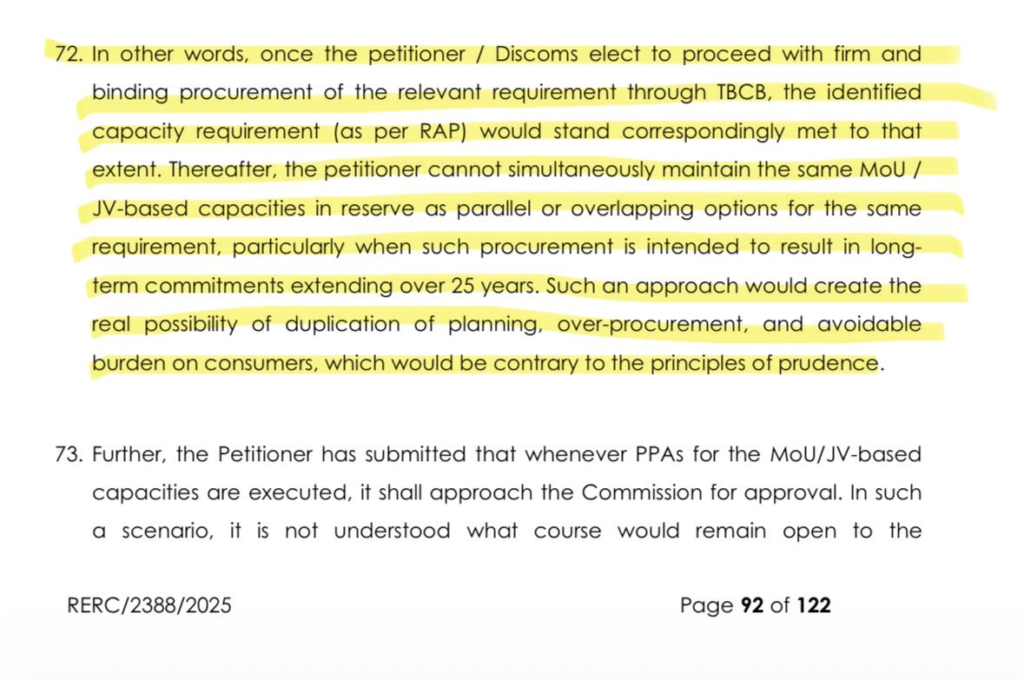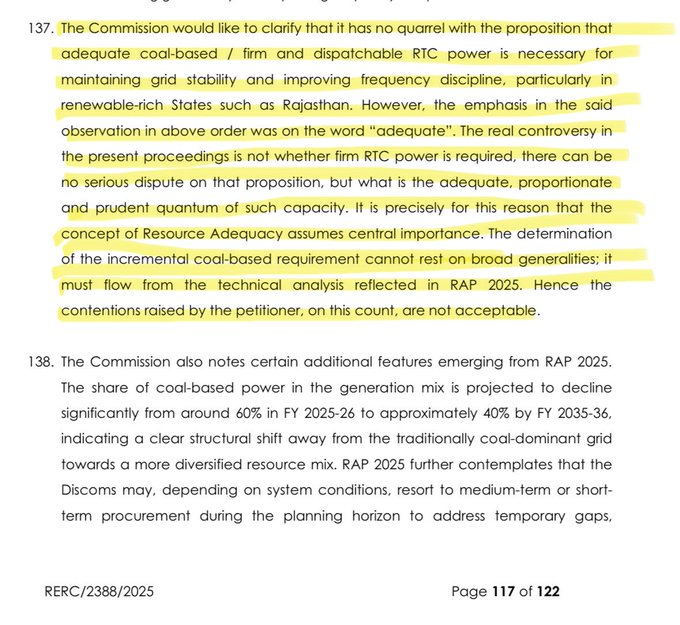
For ordinary consumers and industries in Rajasthan, this is not a dry regulatory argument. The Commission’s concern throughout the order is about fixed charges the capacity payments that consumers must pay regardless of whether the power is actually used. A 25-year PPA for 3,200 MW means Rajasthan’s Discoms will be obligated to pay fixed charges to the developer for a quarter century, regardless of actual demand or the cost of power available from other sources. If the state simultaneously holds MoU-based obligations for 3,335 MW of coal, plus 1,400 MW of nuclear, AND 3,200 MW of new TBCB thermal with significant overlap in timing consumers could end up paying for three parallel sets of fixed charges against the same demand requirement. “Such an approach would create the real possibility of duplication of planning, over-procurement, and avoidable burden on consumers, which would be contrary to the principles of prudence.” (Pic 3) RERC is also flagging a structural shift: by FY 2035-36, coal’s share in Rajasthan’s generation mix is projected to decline from ~60% today to ~40%. New BESS (battery storage) regulations are in force. Rooftop solar and net metering schemes are expected to moderate Discom demand. Locking in a 25-year coal PPA in this environment, without first exhausting cheaper alternatives, may not serve consumer interest. This Order Does Not Say “No Coal, Ever” It is important to be clear about what RERC has and has not decided. The Commission explicitly stated (para 137, Pic 4) that it has “no quarrel with the proposition that adequate coal-based / firm and dispatchable RTC power is necessary for maintaining grid stability.” It has also acknowledged the genuine peak-time challenge that solar cannot address. What RERC is rejecting is this particular procurement, at this scale, at this time, without the required analytical groundwork. The Commission has, if anything, encouraged the MoU/JV route noting that projects like the SCCL Telangana capacity (Cabinet-approved, with credible CPSU counterparties) should be fast-tracked rather than abandoned. It has also opened the possibility of a shorter 10-12 year PPA instead of 25 years, should TBCB eventually be justified. The message is not “stop planning for thermal power.” The message is: plan rigorously, disclose fully, and procure only what is genuinely needed.