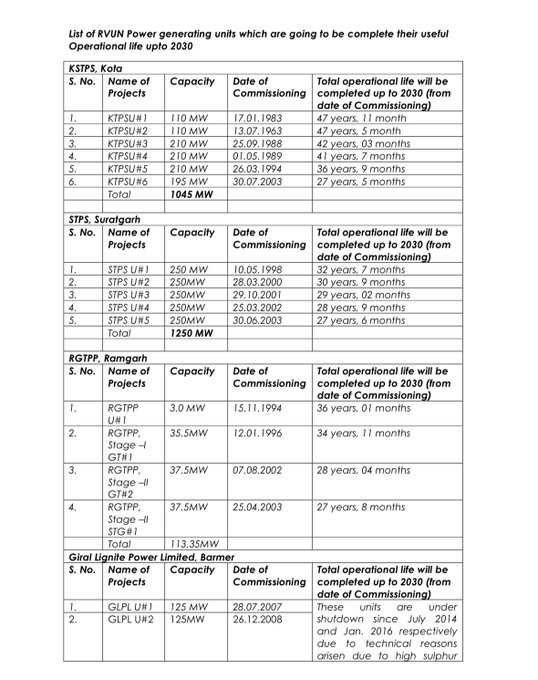

Rajasthan Urja Vikas & IT Services Limited (RUVITL) the state’s bulk power procurement agency wanted to lock in 3,200 MW of new coal-based electricity for 25 years through a competitive bidding process. The Rajasthan Electricity Regulatory Commission (RERC) said no in November 2025. RUVITL went back, armed with a clarification from India’s apex technical body (CEA), and filed a review petition. On 15 May 2026, RERC said No again. This report explains what happened, why the regulator is right to push back, and what the state government must actually do before this procurement can proceed. What Was RUVITL Trying to Do? Rajasthan’s electricity demand has been growing fast roughly 7.5% annually over the decade before 2025. As the state’s share of solar power grows (it is among the top solar states in India), there is a genuine concern about having enough firm, round-the-clock (RTC) power available when the sun is not shining during morning peak hours (7–10 AM) and evening peak hours (6–11 PM). RUVITL proposed solving this by procuring 3,200 MW (four units of 800 MW each) of coal-based thermal power on a 25-year Design-Build-Finance-Own-Operate (DBFOO) basis through a Tariff-Based Competitive Bidding (TBCB) process. The project had a confirmed coal linkage under the central government’s SHAKTI B(iv) policy a rare and valuable commodity. RERC rejected this proposal in November 2025. RUVITL then filed a Review Petition citing new evidence from the Central Electricity Authority (CEA). On 15 May 2026, RERC disposed of this review petition as well reaffirming and substantially strengthening the original rejection. Is There Actually a 3,200 MW Shortage? This is the central disagreement. RUVITL said yes. RERC, after careful analysis, said: not demonstrated on current data. The Commission’s analysis was built on CEA’s own Resource Adequacy Plan (RAP) 2025 for Rajasthan, which projects how much additional coal-based capacity the state needs from FY 2025-26 to FY 2035-36. The key number: 4,440 MW of additional coal capacity is required over the decade. But how much of that 4,440 MW is already in the pipeline? The Commission added it all up:(Pic 1) In plain terms: the state already has plans in place through a mix of joint ventures, MoUs, and a nuclear power allocation that together cover and slightly exceed the assessed need. There is no demonstrated residual gap that would justify locking consumers into an additional 3,200 MW for 25 years right now. What RUVITL Argued and Why RERC Disagreed 1. “The MoU projects are unreliable they shouldn’t be counted” :- RUVITL argued that projects agreed through Memoranda of Understanding (MoUs) like the Chhabra extension with NTPC are still at early stages and cannot be treated as firm capacity. RERC disagreed: these projects were reported by Rajasthan itself to CEA as planned capacity. The SCCL Telangana project had even received Cabinet approval by November 2025 a fact RUVITL never disclosed to CEA when seeking its ‘clarification.’ 2. “The Mahi-Banswara nuclear plant is too uncertain to count” :- RUVITL argued the Mahi-Banswara nuclear project (1,400 MW) has a long gestation period and shouldn’t factor into planning. RERC found this untenable: RUVITL had already given formal consent for 1,400 MW from this project back in 2022. The project has received administrative approval and is projected to commission by FY 2032-33 within the 10-year planning horizon. Critically, this consent was never disclosed to CEA when RUVITL asked it for a ‘clarification’ a material omission the Commission explicitly called out.
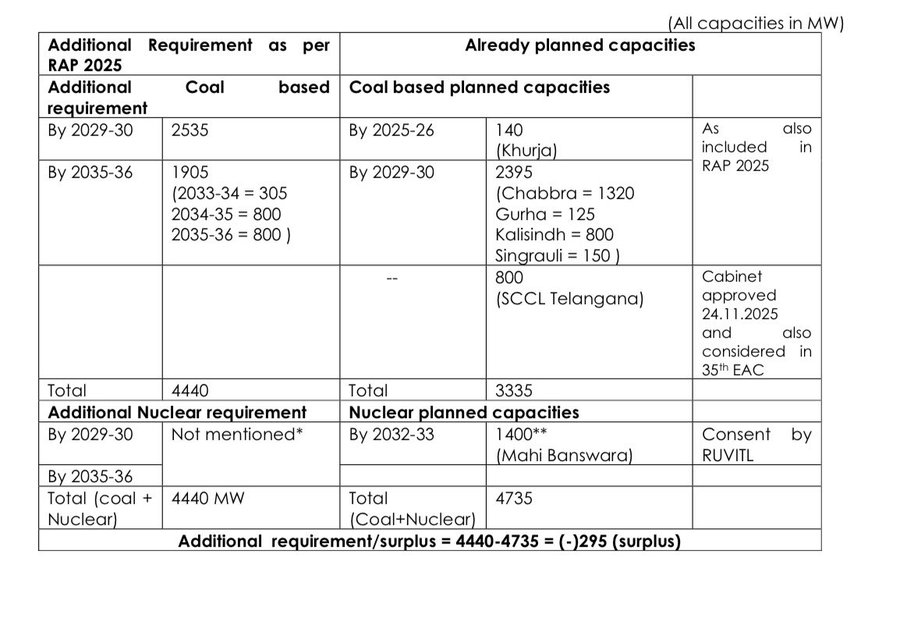
3. “1,350 MW of old plants will retire, this creates a gap” :- RUVITL argued that old units at Kota Thermal (KTPS) and Suratgarh (STPS) totalling 1,350 MW would retire post-2030, creating additional demand for new capacity. RERC found this unsustainable: RVUNL itself wrote to CEA in March 2026 saying no retirement decision has been finalised, and that any such decision would be taken only in/after 2030 subject to prevailing demand and government approvals. RUVITL built its case on a retirement assumption its own sister company won’t confirm. (Pic 2) 4. “CEA has now confirmed 4,440 MW is needed so 3,200 MW is justified” :- After the November 2025 rejection, RUVITL went to CEA, got a letter confirming the 4,440 MW total requirement, and filed a review. RERC read CEA’s letter carefully and found it does not say what RUVITL claims. CEA confirmed 4,440 MW total but 2,535 MW is already planned. CEA retained all MoU/JV capacities in the framework. CEA said the choice of route (MoU vs. competitive bidding) lies with the Discoms. At no point did CEA endorse 3,200 MW TBCB as justified on current data. A Letter Built on Incomplete Facts There is a procedural dimension to this order that deserves attention. When RUVITL wrote to CEA on 24 November 2025 seeking a ‘clarification’ on the coal capacity requirement, it omitted two critical facts: WHAT RUVITL DID NOT TELL CEA 1. The SCCL Telangana capacity (800 MW) had already received Cabinet approval on 19 November 2025 just five days before RUVITL’s letter. RUVITL’s letter made no mention of this. The Commission called this a material non-disclosure. 2. RUVITL had already given formal consent in November 2022 for 1,400 MW allocation from the Mahi-Banswara Nuclear Power Project. This consent was not mentioned in the letter to CEA. CEA therefore could not factor in this nuclear capacity when responding. 3. Because the factual premise on which CEA’s 27 November 2025 clarification was sought was incomplete, the Commission found that CEA’s reply could not be treated as a clean endorsement of RUVITL’s proposal. Had these disclosures been made, the total planned capacity figure would have been even higher making the residual gap argument even weaker. What Must Happen Before TBCB Can Proceed RERC has not permanently closed the door on thermal procurement. But it has set out a clear sequence of steps that must be completed first. In the Commission’s own words (para 114), the Discoms may pursue TBCB if they go through this process: 1Clear Decision on MoU/JV Capacities The Discoms must take a definitive, officially approved decision on which MoU/JV projects to retain in the planning basket and which to formally cancel. Cancellation requires competent authority approval at the same level including Cabinet-level clearance where applicable. Tentative preferences are not enough. 2. Techno-Economic Assessment and Formal Decision on Retirements RVUNL must conduct a detailed techno-economic study of the plants proposed for retirement (KTPS and STPS units). This must cover plant condition, R&M alternatives, cost comparison, and environmental compliance. Only after this can retirement be treated as a firm planning assumption. 3. Independent Socio-Economic and Cost-Benefit Study on Plant Location If the proposed plant is to be located within Rajasthan (rather than near coal mines in eastern India), RUVITL must commission a study quantifying the tariff impact. Stakeholders estimate coal transport adds 15-20% to the cost of power generated; this claim must be tested. 4. Fresh Residual Gap Assessment After the above steps, calculate the actual residual gap using the formula: [4,440 MW total requirement] minus [retained planned capacities] minus [confirmed nuclear allocation] plus [finally confirmed retirement MW]. Also factor in the Planning Reserve Margin per MoP Resource Adequacy Guidelines 2023.