

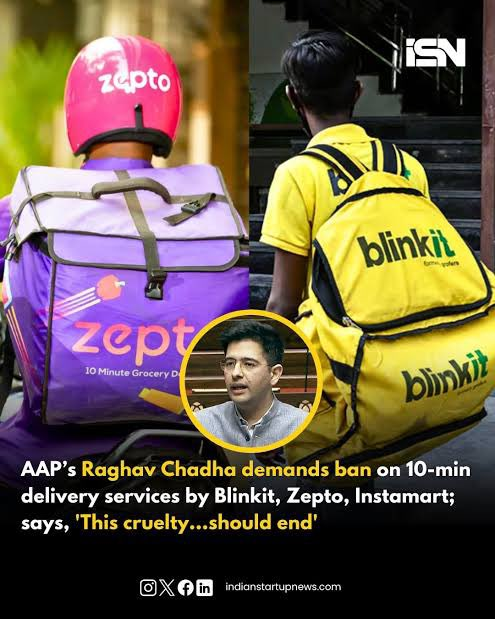
Two-minute delivery did not die a natural death. It was executed swiftly, decisively, and with full political ceremony because it dared to outrun the comfort zone of India’s political economy. What should have been celebrated as a breakthrough in logistics, urban efficiency, and youth employment became a victim of that one thing the state truly excels at: headline management.The official narrative was noble on the surface. Delivery executives were unsafe. Traffic was chaotic. Citizens were alarmed. But stripped of theatrics, the truth is far simpler: innovation moved too fast, and the system panicked.
And no panic is complete without hypocrisy.
After all, nothing says “we care for delivery boys” like taxing them 45–50 percent on every litre of petrol they buy for their scooters. Nothing says “pro-worker” like extracting indirect taxes from individuals earning barely Rs 18,000–22,000 a month. And nothing says “public safety” like ignoring potholes big enough to swallow small automobiles while policing the speed at which a grocery order travels.But if India’s reaction feels bizarre, it becomes even more striking when compared to how other major economies approach similar disruptions.
In the United States, disruptive ideas are not strangled at birth. Uber, DoorDash, and Instacart did not face moral panic; they faced tough debates, lawsuits, and regulatory reform but never a political crusade designed to suffocate them for optics. Innovation came first, adjustments later.
In Europe, quick-commerce faced zoning issues, worker-protection debates, and urban planning challenges. But Berlin didn’t shutter the model because riders looked too fast on CCTV. Paris didn’t eliminate hyperlocal delivery because it generated uncomfortable news cycles. They regulated, negotiated, corrected and kept the industry alive.
In China, rapid delivery is a national capability. The state built e-scooter lanes, battery-swapping networks, and digital logistics infrastructure. Delivery workers are not treated as a problem to be contained but as partners in a hyper-efficient economy. The guiding question was: “How do we scale this safely?” not “How do we make this disappear before prime-time news?”
And then there is India, where innovation is tolerated only if it behaves slowly and doesn’t embarrass bureaucratic pace.
Here, the moment an idea becomes too visible, too fast, or too job-creating, it is framed as a national threat. The same ecosystem that never hesitates to collect taxes from low-income gig workers suddenly transforms into their self-declared guardian angel the minute a disruptive model threatens old narratives. Regulation becomes a weapon, not a tool.While other countries ask how to make innovation safer, India asks how it might look on television tonight.
This is tragic, because India actually needs such innovations more than any of these economies. We have the youngest workforce among major nations. We have dense, chaotic cities begging for efficient logistics. We have millions seeking flexible, entry-level employment. Quick-commerce including ultra-fast delivery was one of the few models where technology and job creation rose together.But in a system where optics dominate outcomes, the wrong thing dies first.The message has now been broadcast to every entrepreneur in the country:
Innovate, but not too fast.
Create jobs, but not too visibly.
Disrupt industries, but never the political narrative.
And whatever you do, do not deliver anything faster than the bureaucracy itself can think.
Two-minute delivery is dead.
But the real casualty is our credibility as a nation that claims to champion innovation. If we continue killing ideas that other economies regulate, refine, and celebrate, we will keep pretending that headlines are progress and mistaking political comfort for national growth.