Home Blog Page 9

लड्डू, चरण पादुका और स्टील फ्रेम का मौन

0

देश में प्रशासन अब दो हिस्सों में बंट चुका है।
एक वह प्रशासन जो समस्याओं को हल करता है।
दूसरा वह जो समस्याओं के साथ फोटो खिंचवाता है।
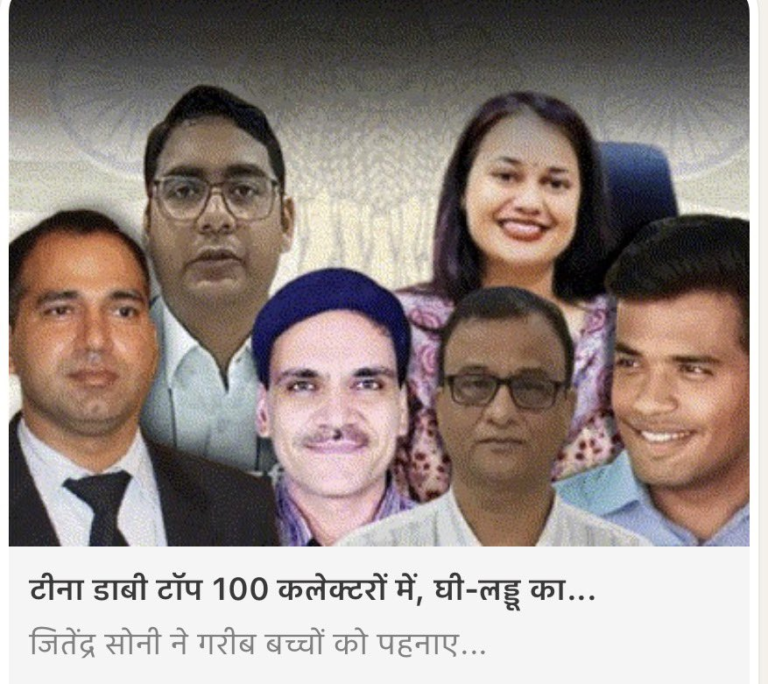
खबर आई कि कुछ कलेक्टर “टॉप 100” में शामिल हो गए।
किसी ने घी-लड्डू खिलाए।
किसी ने चरण पादुका पहनाई।
किसी ने पेड़ों के लिए ऐप बना दिया।
अब पेड़ बचें या न बचें,
ऐप का लोगो बहुत सुंदर होना चाहिए।
पानी आए या नहीं,
लेकिन उसका डैशबोर्ड रंगीन होना चाहिए।
भारत में अब प्रशासन का मूल्यांकन समस्या सुलझाने से नहीं,
“इनोवेशन” नामक एक सरकारी शब्द से होता है।
और इनोवेशन का मतलब क्या है?
किसी सेठ-साहूकार से CSR का पैसा लेकर
कुछ चप्पलें बंटवा दीजिए,
दो किलो लड्डू बंटवा दीजिए,
एक ऐप लॉन्च कर दीजिए,
और प्रेस नोट जारी कर दीजिए ….“जिले में ऐतिहासिक पहल।”
आम आदमी बेचारा सोचता रह जाता है कि
जिस देश में नालियां हर बारिश में उफन पड़ती हों,
जहां सड़कें हर मानसून में गड्ढों में बदल जाती हों,
जहां सरकारी स्कूलों में बच्चे आज भी अंग्रेज़ी से ज्यादा पंखे का इंतजार करते हों,
वहां “ऐतिहासिक पहल” आखिर होती किसे कहते हैं?
भारतीय प्रशासनिक सेवा कभी इंडियन सिविल सर्विसेज कही जाती थी।
औपनिवेशिक काल की वह मशीनरी “स्टील फ्रेम” कहलाती थी।
कठोर थी, कई बार अमानवीय भी थी,
लेकिन उसकी एक छवि थी … फाइल पढ़ने वाले, अध्ययन करने वाले,
नीति समझने वाले अधिकारी।
आज़ादी के बाद उम्मीद थी कि यह स्टील फ्रेम
जनता के लिए झुकेगा।
साहब से सेवक बनेगा।
गांव की धूल समझेगा।
शहर की बदबू महसूस करेगा।
भ्रष्ट बाबुओं के बीच आम आदमी की घुटन पहचानेगा।
लेकिन हुआ क्या?
साहब की कुर्सी तो बची रही,
बस अंग्रेज़ी की जगह हिंदी के प्रेस नोट आ गए।
अब हर जिले में एक नया कलेक्टर आता है।
वह अपनी योजना लाता है।
नाम ऐसा कि लगे संयुक्त राष्ट्र ने योजना बनाई हो।
“मिशन मुस्कान”,
“ऑपरेशन उड़ान”,
“प्रोजेक्ट संबल”,
“जन-संवाद प्लस”।
फिर दूसरा कलेक्टर आता है।
पहले वाले की फाइलें स्टोर रूम में चली जाती हैं।
नई नेमप्लेट लगती है।
नई टैगलाइन छपती है।
पुरानी योजना मर जाती है।
जनता वहीं खड़ी रहती है।
राजस्थान में शायद ही कोई ऐसा जिला होगा जहां
किसी कलेक्टर की बनाई व्यवस्था
दस साल बाद भी उसी मजबूती से चल रही हो।
क्योंकि यहां व्यवस्था नहीं बनती,
इवेंट बनते हैं।
यहां स्थायी समाधान नहीं,
स्थायी प्रचार बनता है।
अगर सचमुच कोई जिला कलेक्टर महान कहलाना चाहता है,
तो वह ऐसा सिस्टम बनाए
जो उसके जाने के बाद भी चले।
ऐसी व्यवस्था जो भ्रष्टाचार कम करे।
ऐसी तकनीक जो जनता को बाबुओं के चक्कर से बचाए।
ऐसी जल निकासी कि शहर डूबे नहीं।
ऐसी शिक्षा व्यवस्था कि सरकारी स्कूल छोड़कर लोग भागें नहीं।
ऐसी बिजली-पानी व्यवस्था जो मंत्री के दौरे पर नहीं,
हर दिन चले।
लेकिन यह कठिन काम है।
क्योंकि इसमें रील नहीं बनती।
इसमें राष्ट्रपति भवन में इनाम वाली फोटो जल्दी नहीं मिलती।
इसलिए आसान रास्ता चुना जाता है।
लड्डू बांटो।
चप्पल पहनाओ।
फोटो खिंचवाओ।
अखबार में छप जाओ।
और जनता?
जनता अगले मानसून में फिर पानी में तैरती मिल जाएगी।
राजस्थान में तो दृश्य और भी अद्भुत है।
करीब 200 विधायक हैं।
मंत्रियों को छोड़ दें तो 175 की संख्या है जो
छोटे-छोटे फ्लैटों में रहते हैं।
लेकिन बड़े अफसरों के बंगले देखिए।
बंगले कम, सामंती स्मारक ज्यादा लगते हैं।
एक-एक, दो-दो बीघा में फैले हुए।
देश लोकतंत्र से चलता है या “साहब तंत्र” से…
कई बार समझना मुश्किल हो जाता है।
शायद इसलिए आम आदमी की समस्या
फाइल में सिर्फ “मामला” बनकर रह जाती है।
क्योंकि जिसने कभी पानी भराव में रात नहीं काटी,
वह ड्रेनेज को प्राथमिकता क्यों देगा?
जिसने कभी सरकारी अस्पताल की लाइन नहीं देखी,
उसे स्वास्थ्य व्यवस्था की बेचैनी कैसे समझ आएगी?
यूरोप, अमेरिका, जापान, चीन…
इन देशों की ब्यूरोक्रेसी का अध्ययन कीजिए।
वहां सिस्टम व्यक्ति से बड़ा होता है।
यहां व्यक्ति सिस्टम से बड़ा हो जाता है।
वक्त शायद सचमुच बदलाव का है।
वरना आने वाले वर्षों में भी
देश के अखबार ऐसे ही चमकते रहेंगे…
“कलेक्टर साहब ने आज 51 बच्चों को जूते पहनाए।”
“कलेक्टर मैडम ने देसी घी के लड्डू खिलाए।”
“कलेक्टर साहब ने पेड़ों के लिए नया ऐप लॉन्च किया।”
और उधर सड़क पर
एक बच्चा गड्ढे के पानी में
नंगे पैर चलता रहेगा।
The argument for GIS-integrated governance is not merely technocratic. It is fundamentally about who bears the cost of bad planning decisions and ensuring that those who make the decisions cannot later claim ignorance of the consequences. When a floodplain is built upon and the floods come anyway, the losses fall on the residents who could not afford to live elsewhere, on farmers whose irrigation depends on a groundwater table that no longer recharges, on women and children who travel further for water in a landscape remade by decisions in which they had no voice. The spatial precision of GIS makes the causal chain between decision and consequence legible in a way that abstractions cannot. That legibility is, in itself, a form of accountability.

0

THREE MEASURES. NO EXCEPTIONS. I.  A mandatory GIS-verified riverbank buffer audit for every development clearance within five kilometres of any mapped watercourse in Rajasthan not as an advisory annex to the file, but as a binding precondition for approval. II.  Environmental spatial data watercourse proximity, recharge zones, historical flood inundation integrated into JDA and UIT approval workflows as enforceable constraints, not consultative checklists. III.  A public, continuously updated GIS portal for Rajasthan’s river systems: open to researchers, journalists, courts, and the communities who live downstream and absorb the costs of decisions made upstream. The Sahibi river once flowed freely through Haryana and into Delhi. It now enters the capital as the Najafgarh Drain diminished, contaminated, renamed into anonymity. That transformation was not the work of indifference. It was the work of a planning system that processed each encroachment as a local, bounded decision while the cumulative damage remained no one’s specific responsibility. The renaming is almost elegant in its honesty: when a river becomes unrecognisable, we simply give it a new name and pretend the old one never existed. GIS cannot restore what has already been lost. But it can make the next loss undeniable visible, documented, attributed. The maps are ready. The satellite archives are deep and growing. The question that remains is the oldest one in environmental governance: not whether we have the knowledge to act, but whether our institutions have the integrity to be governed by what they know.

India’s rivers are not disappearing. They are being erased one approved layout plan at a time. The technology to stop it has existed for decades. What has been missing is the political will to use it.

0

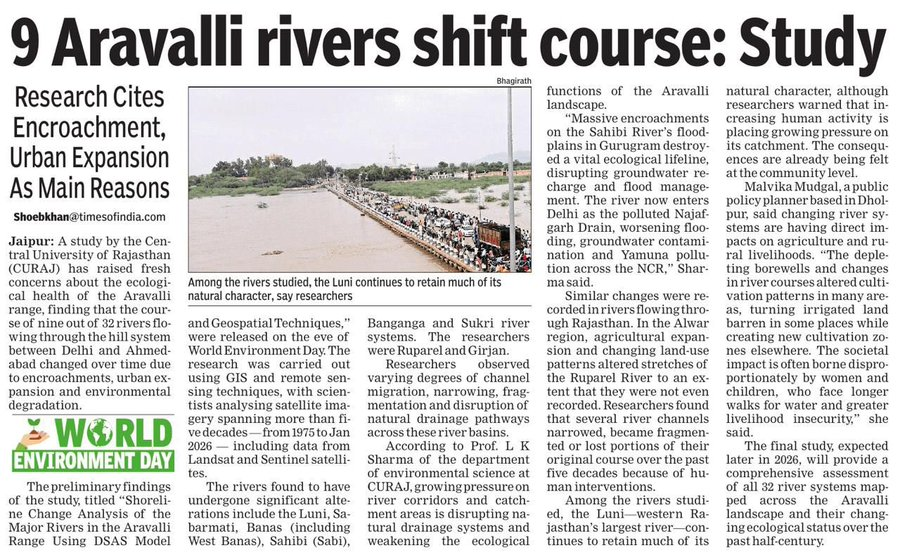
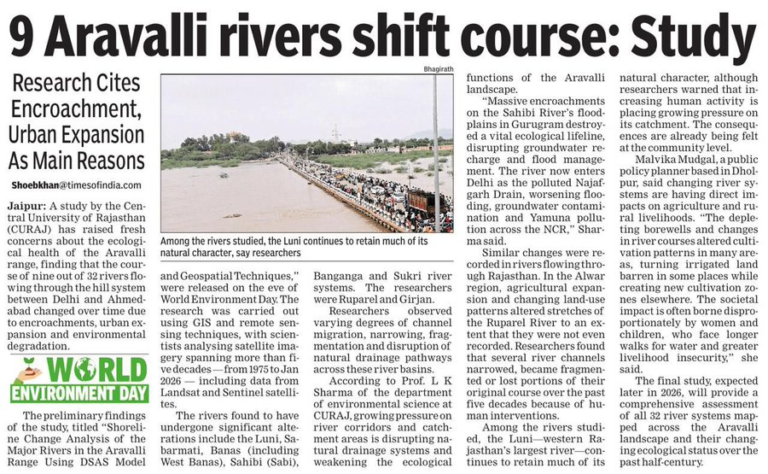
Nine rivers in the Aravalli range one of the world’s oldest mountain systems, older than the Himalayas, spanning the ecological spine of northwestern India have measurably shifted course over the past five decades. They have narrowed, fragmented, lost portions of their channels to cities that were planned, approved, and built as if the rivers were an inconvenience rather than the reason the land was livable at all. Nobody was prosecuted. Few were even publicly embarrassed. The rivers simply moved, and the official maps were quietly redrawn to accommodate the new reality. This is the grammar of environmental collapse in the world’s most populous democracy: not catastrophe, but attrition. Not a single villain, but a bureaucratic ecosystem so diffuse in its culpability that accountability becomes structurally impossible. A residential colony absorbs a floodplain here. An industrial estate constricts a river corridor there. A highway is routed through wetlands that were not, technically, gazetted as wetlands. Each decision survives its own scrutiny. Their cumulative consequence does not. “In India, environmental knowledge has rarely suffered from a shortage of data. It has suffered from a shortage of consequence.”   Geographic Information Systems GIS represent the most potent challenge to this architecture of evasion that planning governance has yet produced. Satellite imagery does not forget. It is not susceptible to jurisdictional reshuffling, political telephony, or the slow bureaucratic digestion that renders environmental impact assessments irrelevant by the time a project breaks ground. A GIS overlay a city’s sanctioned land-use map set against its actual built footprint, cross-referenced against a river’s documented course in 1975 and again today generates something that planning committees have spent generations learning to avoid: a timestamped, spatial, irrefutable record of what was decided, and precisely what it destroyed. Western Rajasthan’s largest river continues to retain much of its natural character a distinction that should be a baseline, not an achievement. The Jojari, which carries Jodhpur’s textile effluents into the Luni basin, has no such distinction. Both rivers remain largely absent from the state’s development planning framework. The stakes for Rajasthan are not abstract. The Jojari carries Jodhpur’s textile effluents chromium, synthetic dyes, untreated discharge into the Luni, which drains a catchment that sustains agriculture across some of the most water-scarce terrain on the subcontinent. The Banas, the Chambal, the Banganga are not merely scenic or sentimental assets. They are the functional infrastructure of groundwater recharge, flood attenuation, and agricultural viability across vast stretches of the state. Their ecological integrity is not a separate policy domain from urban planning or industrial regulation. It is the same question, being answered badly in multiple places simultaneously. Yet Rajasthan’s development approval machinery the Jaipur Development Authority, Urban Improvement Trusts, Special Area Development Authorities scattered across the state continues to process project clearances without mandatory spatial cross-checks against watercourse proximity, historical inundation data, or groundwater recharge zone maps. The relevant data exists. It sits in satellite archives maintained by ISRO and the European Space Agency, in river atlases published by the Central Water Commission, in environmental surveys conducted by state and national agencies. In India, environmental knowledge has rarely suffered from a shortage of data. It has suffered from a shortage of consequence.

When the Sangh’s cultural nationalism attempts to subsume tribal identity within the framework of “Vanavasi,” scholars like Ganga Sahay resist that redefinition.

0

This struggle is invisible, but in the long-term view, it is also the most decisive.

The Sangh’s Experiment and Its Limitations

The BJP-Sangh’s relationship with the Meena society is a profound strategic irony. Central government policies regarding the Meena-Mina dispute have repeatedly challenged the community’s internal unity. The Vasundhara Raje government once imposed a ban on the mutual interchange of the names “Mina” and “Meena,” but after widespread agitation by Meena leaders, that order had to be withdrawn.

According to the National Meena Mahasabha, the Meenas are Rajasthan’s only Scheduled Tribe, and they will not permit the inclusion of any other community in their category. This is the language of identity defense, which is as constitutional as it is political.

The Sangh seeks to assimilate tribal societies into the Hindu cultural mainstream through the “Vanavasi Kalyan Ashram.” But the Meena society’s consciousness clashes directly with this definition—their identity is Adivasi, not Vanavasi. This word-difference is an ideological battleground.

The Real Crisis: A Transitional Period for Leadership

In 2026, Meena politics is grappling on three fronts at once. First, there is no universally accepted leader after Kirodi. The BJP has no face from the Meena society with the kind of grassroots hold that Kirodi had. The Congress has leadership, but no credibility.

Second, the simmering discontent of the new generation. In every scandal involving NEET, REET, or police recruitment exams, Meena youth are directly affected. For this society, which relies on public employment, recruitment scams are not merely corruption—they are a question of existence.

Third, the deep chasm between intellectual and political streams. Scholars like Ganga Sahay who are raising questions do not find an echo in the politics of Kirodi or Naresh. And until this chasm is bridged, the accumulated energy of Meena society will continue to scatter.

Muhana: In Which Direction?

The emergence of the Bharat Adivasi Party (BAP) in Rajasthan’s tribal politics is a clear signal. Under BAP’s leadership, a sharp confrontation has already occurred between tribal communities and the police in Udaipur. The ground for a third option is being prepared—slowly, but certainly.

The yaksha question before Meena society is this: Will they remain a tool within the BJP? Or return to the Congress’s old embrace? Or will they seek a new political language that can accommodate both their socialist nature and Adivasi identity?

Kirodi’s answer lay in the BJP. Naresh Meena’s answer lies in rebellion. Ganga Sahay’s answer lies in ideas.
Perhaps the real answer is at the confluence of all three—and until that confluence happens, Meena politics will remain like a river that is thirsty even in flood.

The Fortress of Reservation and the Exile of Ideology

0

Meena Politics: Socialist Roots, Saffron Shade, and the Surging River of Rebellion

In Rajasthan’s politics, the Meena community has become a strange paradox. The tribe, standing as the pivot of constitutional rights, has become the state’s most organized political force, yet today it is being pulled in three different directions: on one side, the BJP’s lure of power; on the other, the Congress’s old shop; and on the third, a new, unorganized but smoldering resistance.

This is not merely an electoral equation. It is a civilizational crisis.

The political consciousness of the Meena community was not forged in fields and farmlands, but in files and courtrooms. After receiving Scheduled Tribe status in 1956, Meena youth in districts like Dausa, Sawai Madhopur, Karauli, and Tonk in eastern Rajasthan saw government jobs as the sole path to liberation. In Rajasthan, a large portion of Scheduled Tribe reservation goes to the Meena community—this fact is as much proof of their organized energy as it is the source of accusations raised against them.

This economic consciousness naturally gave rise to a leftist-socialist tilt. Rights over state resources, constitutional protection, and collective mobility—these values have been the soul of Meena politics. The Congress remained the political expression of this community for decades on this very axis.

Kirodi: A Fire, Now Buried in Ashes

Kirodilal Meena is the “Kirodi Baba” of eastern Rajasthan. He has had deep influence in Meena-dominated districts like Dausa, Sawai Madhopur, and Karauli, and is considered the community’s biggest leader. Kirodi, who fought on the ground for decades against Congress governments, struck a strange deal with the BJP: power in exchange for community.

But the 2024 Lok Sabha elections exacted the price of this deal. Kirodilal Meena had taken responsibility for seven Lok Sabha seats in eastern Rajasthan for the BJP, but the party lost seats like Dausa, Bharatpur, Karauli-Dholpur, and Tonk-Sawai Madhopur. Taking moral responsibility for this defeat, Kirodi resigned from his ministerial post.

Analysts believed that while Kirodi Baba got the agriculture department, influential portfolios like Panchayati Raj were taken away from him. The firebrand leader was gradually realizing that his stature in power was being diminished. This was not just a resignation—it was an expression of the pain of a tribal leader who, even while remaining within the BJP, felt cut off from his roots.

Chief Minister Bhajanlal Sharma could not arrive at any clear decision on Kirodi’s resignation: on one side, the fear of the Meena community’s anger; on the other, pressure from the organization. This dilemma itself reveals how indispensable yet inconvenient the Meena vote is for the BJP.

Naresh Meena: The Politics of Slaps and Their Symbolism

What happened during the Deoli-Uniara by-election in November 2024 was not just an incident—it was a symptom. Independent candidate Naresh Meena publicly slapped a sub-divisional officer in Samarwata village during voting, leading to tension across the entire area. His supporters set fire on the highway.

There is no doubt this was personal recklessness. But behind it lay a deep social discontent. Naresh Meena went to jail, and later sat on an indefinite fast unto death demanding justice in the Jhalawar’s Piplodi school tragedy. This is the paradox of this leader: unrestrained in conduct, yet sensitive to the community’s pain.

In the by-election, Naresh Meena, as an independent candidate, secured nearly 30 percent of the votes to come in second place, leaving Congress behind. This figure shows that in the leadership vacuum created after Kirodi, a large section of the Meena community is ready to embrace any rebellious voice to fill it, no matter how controversial that voice may be.

Ganga Sahay Meena: A New Language of Intellectual Resistance

Where Kirodi and Naresh are products of the political arena, Ganga Sahay Meena comes from an entirely different terrain. An Associate Professor at JNU’s Centre for Indian Languages, hailing from Seva village in Sawai Madhopur district, Ganga Sahay Meena is the founder-editor of the magazine Adivasi Sahitya.

His significance is not merely academic. He represents an intellectual tradition that elevates Meena identity above the debate on reservation, linking it to civilizational questions: forest rights, linguistic identity, the rewriting of tribal history.

PM Surya Ghar Yojana

0

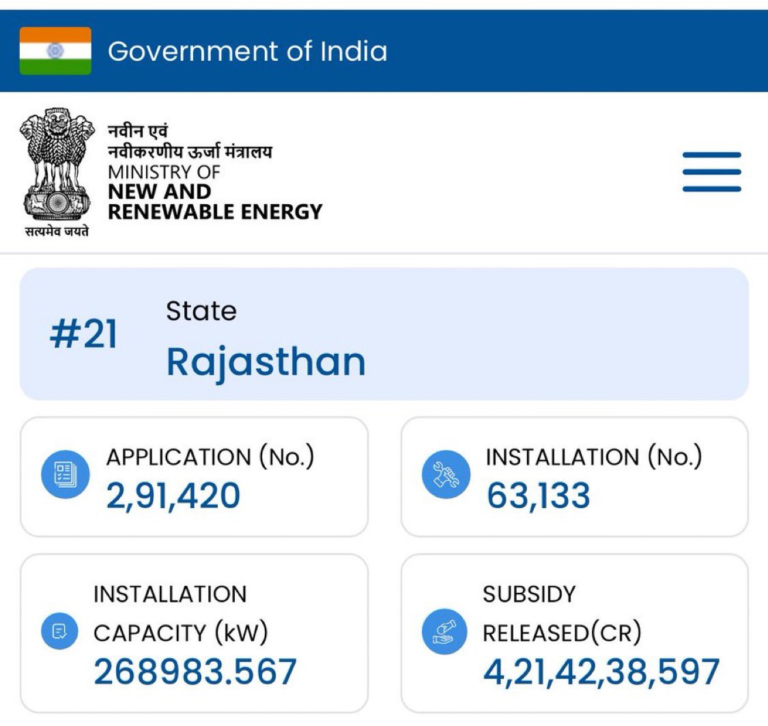
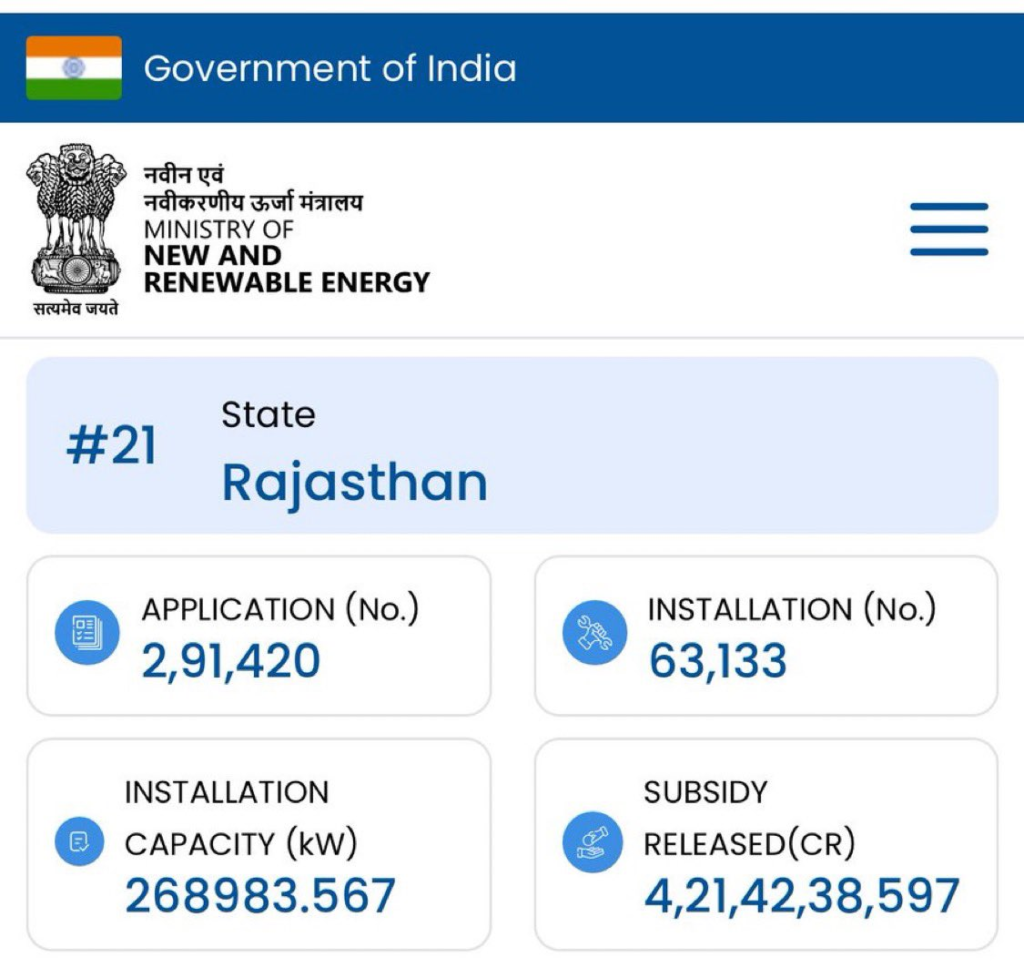
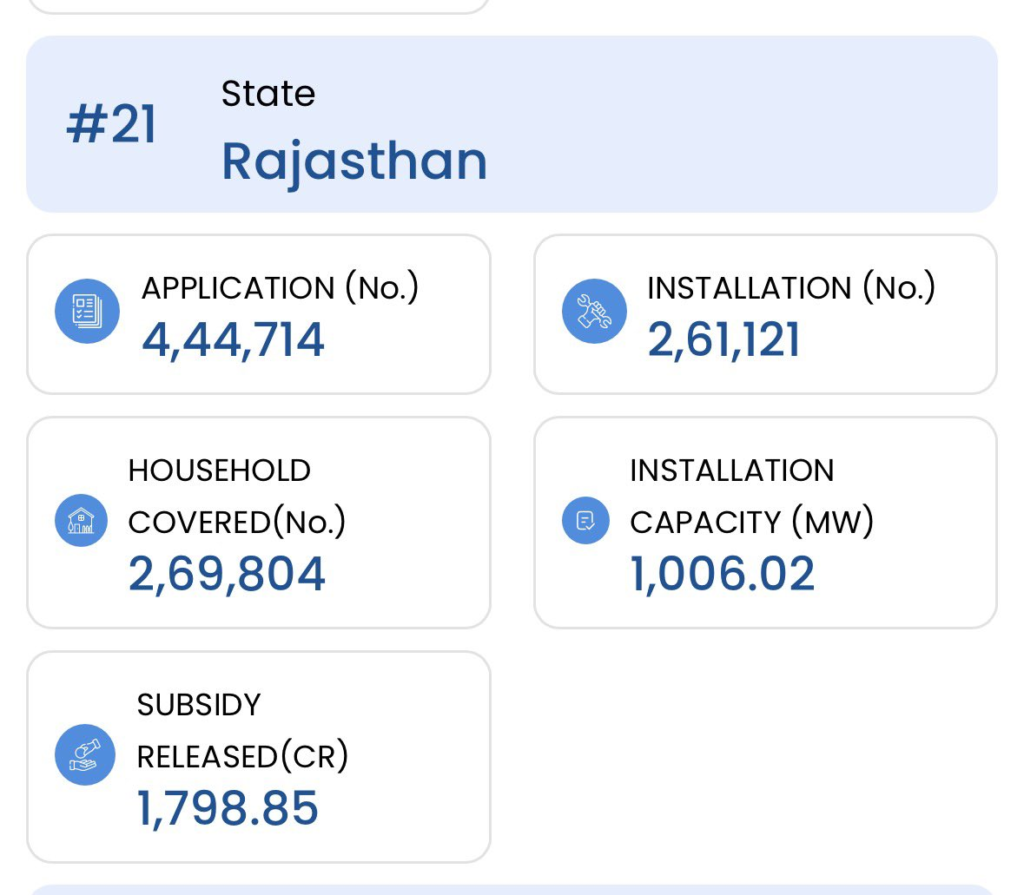
Rajasthan Progress (29 July 2025 – 16 July 2026) Applications: Increased from 2,91,420 to 4,44,714 (+1,53,294; +52.6%). Installations: Rose from 63,133 to 2,61,121 (+1,97,988; +313.6%). Installed Capacity: Increased from 268.98 MW to 1,006.02 MW (+737.04 MW; +274%), crossing the 1 GW milestone. Subsidy Released: Increased from ₹421.42 crore to ₹1,798.85 crore (+₹1,377.43 crore; +327%). Households Covered: 2,69,804 households benefited under the scheme as of 16 July 2026

Unemployment among youth aged 15 to 29 is nearly three times the national average. On the other hand, India presents itself as a global AI and technological power. This is the biggest paradox. The unemployment rate among youth aged 15 to 29 is nearly three times higher than the national average, while the country positions itself as an emerging force in AI and technology. This contradiction means that the “demographic dividend” (youth population) is being prepared for jobs that no longer exist in that form—this is the real fuel behind today’s student movements, far bigger than any single paper leak.

0

What should real change look like? Simply adding a coding class or distributing tablets in schools is not education reform. For genuine transformation, three fundamental changes are essential. First, the single-exam-based system must be abolished. Both China and the United States, in their own ways, are moving evaluation toward continuous and multidimensional assessments spread throughout the entire educational journey. India too should shift from a make-or-break single-day exam to multiple evaluation opportunities, secure digital proctoring, and portfolio-based assessments of students’ actual skills. This would reduce the benefits of cheating and lower the cost of any single paper leak. Second, AI literacy must be made a core part of the curriculum, not an optional add-on. Like in China, the use of AI, understanding its limitations, fact-checking, and critical evaluation should be taught from the early grades. If this doesn’t happen, AI will become a new divide between rich and poor students in India, where affluent families are already giving their children an extra edge through coaching. Third, and most importantly, the mindset that confines education to preparation for limited government jobs must change. Every year, millions of youth chase the same few secure jobs, whose numbers aren’t growing. Instead, skill-based vocational education, industry-linked apprenticeship programs, and flexible systems for re-education or skill acquisition at any stage of life will be far more crucial. If India squanders this opportunity Using tear gas on students cannot be justified in any situation. At the same time, impartial investigations and accountability for incidents like paper leaks are also essential. But if the response to this entire movement is limited to just ousting a minister or introducing new anti-cheating software, India will squander its “historic moment for the Gen Z generation” on superficial reforms. Meanwhile, China is forging ahead in transforming an entire generation into an AI-enabled workforce, while the United States continues to give its private sector the freedom to experiment. The students who have embraced calling themselves “cockroaches” are not just demanding fair exams. They are raising the fundamental question of whether, in today’s world reshaped by artificial intelligence, it is still fair to have a system where one exam, one chance, and ultimately limited secure jobs are the sole purpose of the entire education—while the whole world is being transformed by artificial intelligence. India must not just give them better exams, but rebuild the entire education system.

Dharmendra Pradhan’s resignation means the cockroaches are right: India doesn’t need better exams, but a new education system

0

For the past several weeks, New Delhi’s Jantar Mantar has been filled with youth. They call themselves the “Cockroach People’s Party”—a name once used as an insult, but which they have turned into a symbol of their identity and resistance. Their movement isn’t against just one leaked question paper; it’s against the entire education system.

The NEET exam was canceled and re-conducted following allegations of a paper leak. Irregularities were also alleged in CBSE’s on-screen evaluation system. Over the past decade, there have been more than a hundred paper leak incidents, affecting the futures of millions of students. Tear gas was fired at teenagers peacefully protesting with the Constitution in hand. This scene alone should be signal enough for policymakers that this isn’t mere anger over administrative lapses—it’s a generation’s rebellion against a system built on rote memorization, a single day’s exam, and promises of limited government jobs.

The central government’s first response will likely be the same again: a new proctoring system to prevent leaks, a more secure question bank, or the exit of a few officials. But that would be the biggest mistake. These protests are just symptoms; the disease runs much deeper.

India’s exam culture is still a relic of that industrial age, when a single exam, on a single day, with a single result could determine a young person’s entire life. Yet today’s economy demands jobs that seek adaptability, decision-making skills, and the ability to work with AI tools—none of which are tested for, nor systematically taught.

If India wants to understand what the education of the future should look like, it must carefully examine the diverse models emerging around the world.

Two Models, One Crossroads

China has embraced AI not as an elective subject, but as the foundation of its education infrastructure. Under its national “AI+ Education” initiative, launched as part of the 15th Five-Year Plan in 2026, AI literacy becomes mandatory from primary school onward, with a goal of developing a fully integrated AI education system by 2030.

This isn’t just policy—it’s ground reality. By the end of 2025, Beijing claimed that nearly 88 percent of its schools had begun using AI. In cities like Shenzhen, students receive at least one AI-focused lesson every month. In a Beijing secondary school, AI analyzes weeks of homework and quizzes to identify students’ weaknesses and generates personalized practice exercises, which teachers refine and implement.

China’s stated goal isn’t for students to blindly trust AI, but to learn to use it like a co-pilot—a tool whose advice they scrutinize, verify, and challenge when necessary.

In contrast, America has taken a more decentralized, market-driven path. It’s promoting AI research at the federal level, industry-education partnerships, and teacher training, but implementation varies across states and districts.

In America, the debate around AI in education remains largely defensive, focused on catching cheating and maintaining academic integrity. A uniform national strategy for teaching AI as a life skill hasn’t yet materialized.

The strength of this model is its flexibility and freedom for innovation, but its biggest weakness is that it widens the gap between resource-rich and resource-poor schools.

India, for now, isn’t moving in either direction. Here, an “exam industry” has taken root, where high-stakes tests like NEET, JEE, and UPSC have become gateways to limited opportunities. A massive coaching industry has sprung up around them, extracting a heavy financial toll from families so their children can prepare for that one day’s exam.